After a long hiatus I made some araza jam this morning. There's a small season starting and I was able to pick 2/3rds of a bucket of fruit to make 11 jars of what has become our signature jam. I also found just enough nutmeg to make two jars of nutmeg butter. What incredible smells filled the kitchen! Especially as we were also slicing ginger and processing black pepper.
I've been trying to make fudge these last two days. Back in the US, my class would make and sell fudge by the caseload for Christmas fairs. We could knock out fudge like no-one else and had all the packaging and presentation - and sales talk - down to a tee. But this is the first time I've tried it in three years and the recipes from up north don't work so well due to temperature and humidity differences, plus the farmer won't eat butter (!). And there's the caveat that everything we offer at the farmers' market comes from the farm. So. Here's my new recipe:
Coconut Chocolate Fudge
one serving (enough for 4 people after dinner treat)
1 1/2 cups sugar
1/4 cup coconut oil
2/3 cup coconut milk
1/2 cup powdered cacao
1/4 teaspoon vanilla
Melt oil, milk and sugar together in heavy bottomed pan, bring to boil and boil until it reaches the soft ball stage. Remove from heat and stir in vanilla. Wait for 5 minutes then stir in powdered cacao. Wait 5 more minutes then beat until mixture loses its glossiness. Pour into silicon mold (or onto greased parchment paper). Allow to cool before eating (if possible). The cacao and coconut milk comes from the farm, the oil came from Bastimentos Island, the vanilla from Mexico (but soon from our farm) and the sugar from the store. No photos, we ate it before I had the chance to bring out the camera.
Showing posts with label making jam. Show all posts
Showing posts with label making jam. Show all posts
Wednesday, 4 November 2009


Friday, 2 October 2009
three burners, three pots, three jams . . . oh my!

Today was a jam day. A lovely, bubbling, boiling, sugary, syrupy, fruity day. With a massage at the end (thanks Maria!).
I have a three burner gas stove in the kitchen. I love this stove, it has a black glass top, automatic ignition and there's space around the burners for all sorts of spoons, spatulas, jar lids and measuring/pouring devices. It's wonderfully easy to clean and looks good.
Today, as most days, it was busy. I had jam orders to fill and just about enough fruit to do it. We have a client who wants to sell our products in a health food store in San Jose, she wants a sample jar of every jam we make. I've explained to her a couple of times that our jams are seasonal - I use what's on the trees until there's no more left, and then I use what's coming into fruit next, and on it goes. She understands what I say, but the gap between understanding and understanding can be large at times - especially when we live in a world where everything is always available (so it seems even for those in Costa Rica). Seasonal is an empty word for most of us.
But that's the beauty of my work - I can never get bored of making the same thing - two months or less and that fruit I thought I'd always have is gone and something new has to be created for what's up next.

Having said that, there are fruits which have seasons throughout the year - and these were the ones I concentrated on today. Taking the beagle, I set off looking for nutmegs. The main harvest comes in the spring, but most of the time one can find 2 or 3 or 5 or 6 ready and open. Today I found 5 - just enough for 2 pots of jam.

Next we headed to the araza - a tiny gathering of 12 fruit, enough for about 4 pots. We had more luck with the cas, but the season is winding down after 2 glorious months.

By the kitchen I picked up half a box of mangosteen, and a couple of limes. The mangosteen has maybe another 3 weeks to go, I'll be sorry to see it go, for a whole year too.
Back in the kitchen I peeled, chopped and simmered the nutmegs while I opened the mangosteen and slipped the seedless segments into the blender. The seeded segments have to be squeezed - the seeds add too strong a flavour to the jam. I blended the mangosteen pulp and began to cook it down in a pot while I pureed the nutmegs. The araza had to be washed, halved and the seeds and goop scooped (think overripe pumpkin), then chopped, put in a pot and cooked down also. Then came the adding of sugar - white cane sugar for the mangosteen and araza, and raw brown cane sugar for the nutmeg. Grate some more nutmeg and sprinkle some cinnamon into the nutmeg butter, add lime juice to the mangosteen, and try to stir three pots simultaneously while telling the beagle he had better not chew my baskets for the market. Think about coffee and wish the farmer would appear and make some.
The nutmeg has a tendency to sputter and spit, but today no, thankfully. The mangosteen came out a beautiful pink, and has the best flavour so far (2 limes to 1/2 a box of mangosteen, about 3 handfuls of sugar). The araza behaved impeccably as usual and set up first. And the cas? Well that was scooped, strained and is sitting in the fridge waiting to become fruit leather tomorrow. After all I had my massage to go to.
Sunday, 6 September 2009
hot jobos cause explosion
I knew it would happen. It was like the day I learned to ride my bike: I cycled over broken glass and it didn't harm my tires, so I turned back and did it again - 2 flat tires and no more bike riding. It was the same with the jobos.
I knew I wasn't supposed to put hot things in my plastic jugged blender, but the day before I had been impatient and had done it anyway without any ill effects. So I reasoned that I could do it again, being careful not to put too many in. But wrong. Within a few seconds the plastic exploded sending shards all over the kitchen, spraying walls and counter tops with hot jobo juice and sending the scalding pits flying everywhere. The blade continued to whir, effectively cleaning out all of the hot sticky mess, until I could reach behind it and yank the plug out the wall.
That was the end of that experiment.
We have three large jobo trees which have been dropping copious quantities of thumb length, fat, yellow brown fruit for weeks now. The jobo is related to the jocote and the june plum, both of which give larger fruits than this smaller cousin, and both of which are sold in markets and by roadsides all around Costa Rica. I like the taste - very apricot like in a sour kind of way, and strongly flavoured. However the pit is large and the fruit fibrous: not so practical for my purpose.
And yet . . . well we have three large trees dropping fruit I'm stepping on as I harvest carambolas. What to do? I'm giving vinegar a go - fill a bucket, cover, shake periodically, strain a month later, bottle for several more months. The fruit is somewhat sweet, it should make vinegar. And jam? Well the taste tells me yes, but scraping that 1/8th inch flesh from round the seed - is a little crazy making, especially when I've got ALL this other fruit piling up in the kitchen. So I thought I'd simmer it a little to soften and extract as much of the juice, then throw it in the blender and strain it.
So now I've had to just stick with the juice - not a lot to work with, but we'll see. If I can make a syrup that would be fine. A long time ago I made sloe gin. I think jobo gin might be quite nice . . .
I knew I wasn't supposed to put hot things in my plastic jugged blender, but the day before I had been impatient and had done it anyway without any ill effects. So I reasoned that I could do it again, being careful not to put too many in. But wrong. Within a few seconds the plastic exploded sending shards all over the kitchen, spraying walls and counter tops with hot jobo juice and sending the scalding pits flying everywhere. The blade continued to whir, effectively cleaning out all of the hot sticky mess, until I could reach behind it and yank the plug out the wall.
That was the end of that experiment.
We have three large jobo trees which have been dropping copious quantities of thumb length, fat, yellow brown fruit for weeks now. The jobo is related to the jocote and the june plum, both of which give larger fruits than this smaller cousin, and both of which are sold in markets and by roadsides all around Costa Rica. I like the taste - very apricot like in a sour kind of way, and strongly flavoured. However the pit is large and the fruit fibrous: not so practical for my purpose.
And yet . . . well we have three large trees dropping fruit I'm stepping on as I harvest carambolas. What to do? I'm giving vinegar a go - fill a bucket, cover, shake periodically, strain a month later, bottle for several more months. The fruit is somewhat sweet, it should make vinegar. And jam? Well the taste tells me yes, but scraping that 1/8th inch flesh from round the seed - is a little crazy making, especially when I've got ALL this other fruit piling up in the kitchen. So I thought I'd simmer it a little to soften and extract as much of the juice, then throw it in the blender and strain it.
So now I've had to just stick with the juice - not a lot to work with, but we'll see. If I can make a syrup that would be fine. A long time ago I made sloe gin. I think jobo gin might be quite nice . . .
Monday, 6 July 2009
Jam on
Well wasn't I just complaining that the araza season was over and the carambolas were at least a month away? Wrong, wrong, wrong. I was out picking cas and lovi-lovi yesterday and saw several carambolas lying on the ground - on the ground no less! Clearly those at the top of the tree are ripening faster than those I can see on the lower branches. I had only moments before been lamenting the fact that I really needed a few early carambolas to try out recipes before the main harvest began. And once again I got exactly what I asked for.
Carambolas are rather beautiful and strange. Native to Sri Lanka and the Moluccas they have spread all over Asia and now all tropical and subtropical regions. Starfruit in English because the fruit has 5 raised ridges running along its length (rarely 4 or 6 ridges), and when sliced the ridges and the seeds make a nice double 5 pointed star. The fruit tends to be sour, with a fairly detectable oxalic acid content. Sweet carambola do exist, but they're not really so sweet. The fruit is pale to rich yellow when ripe, has a crisp texture and gives a good amount of juice. People tend to use the fruit as a decoration, or juice it, it doesn't have much of a strong character by itself. But it makes a great salsa and can be used for relish and jam.
It's tricky getting carambola jam to set up. There is little if any natural pectin in the fruit and so it must be mixed with something else, hence my need to try out different ideas. I've made two types today, both very different and I think both good, though one certainly wins in presentation.
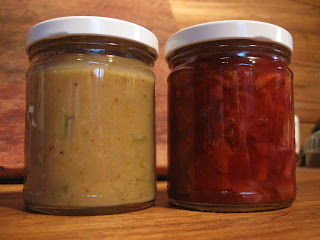
The jar on the left is a Carambola Butter with Lime and Black Pepper, the one on the right is a Carambola Lovi-Lovi Marmalade.
The butter was made by pureeing the fruit first then cooking up with sugar and the juice and flesh of a couple of limes (I boiled the rinds until tender then added to the cooking butter), I added a good teaspoon of our freshly ground black pepper as it was simmering. The butter has the fresh smell of carambola and the lime comes through strongly in the flavour; the pepper gives it a nice warm glow and spicy aftertaste.
4 cups pureed carambola (I compost the hardest part of the raised ridges and the ends, everything else goes into the blender)
1 1/2 cups brown sugar
juice, flesh and rind of 2 limes
big teaspoon ground black pepper
Prepare the rind of the limes by chopping finely and boiling in water for a good 10 minutes. Meanwhile combine other ingredients, bring to quick boil and simmer. Add in rinds and continue simmering for another 10 minutes or so until it thickens and a teaspoon of mix gels (see araza pictures, the butter won't set as well having a different consistency). Can in hot water bath.
The marmalade was much simpler, just a combination of chopped carambola and lovi-lovi in about a 3:1 ratio cooked with sugar, and a little squeeze of lime to bring out the flavours. It has a sweet tangy flavour and the texture and presentation are great.
1 1/2 lbs chopped carambola
1/2 lb lovi-lovi
between 1/2 and 3/4 lb brown sugar to taste
juice of 1/2 lime
mix ingredients, bring to boil and simmer until juice thickens. Test on spoon. This one takes a little longer to set up. Can appropriately!
Carambolas are rather beautiful and strange. Native to Sri Lanka and the Moluccas they have spread all over Asia and now all tropical and subtropical regions. Starfruit in English because the fruit has 5 raised ridges running along its length (rarely 4 or 6 ridges), and when sliced the ridges and the seeds make a nice double 5 pointed star. The fruit tends to be sour, with a fairly detectable oxalic acid content. Sweet carambola do exist, but they're not really so sweet. The fruit is pale to rich yellow when ripe, has a crisp texture and gives a good amount of juice. People tend to use the fruit as a decoration, or juice it, it doesn't have much of a strong character by itself. But it makes a great salsa and can be used for relish and jam.
It's tricky getting carambola jam to set up. There is little if any natural pectin in the fruit and so it must be mixed with something else, hence my need to try out different ideas. I've made two types today, both very different and I think both good, though one certainly wins in presentation.

The jar on the left is a Carambola Butter with Lime and Black Pepper, the one on the right is a Carambola Lovi-Lovi Marmalade.
The butter was made by pureeing the fruit first then cooking up with sugar and the juice and flesh of a couple of limes (I boiled the rinds until tender then added to the cooking butter), I added a good teaspoon of our freshly ground black pepper as it was simmering. The butter has the fresh smell of carambola and the lime comes through strongly in the flavour; the pepper gives it a nice warm glow and spicy aftertaste.
4 cups pureed carambola (I compost the hardest part of the raised ridges and the ends, everything else goes into the blender)
1 1/2 cups brown sugar
juice, flesh and rind of 2 limes
big teaspoon ground black pepper
Prepare the rind of the limes by chopping finely and boiling in water for a good 10 minutes. Meanwhile combine other ingredients, bring to quick boil and simmer. Add in rinds and continue simmering for another 10 minutes or so until it thickens and a teaspoon of mix gels (see araza pictures, the butter won't set as well having a different consistency). Can in hot water bath.
The marmalade was much simpler, just a combination of chopped carambola and lovi-lovi in about a 3:1 ratio cooked with sugar, and a little squeeze of lime to bring out the flavours. It has a sweet tangy flavour and the texture and presentation are great.
1 1/2 lbs chopped carambola
1/2 lb lovi-lovi
between 1/2 and 3/4 lb brown sugar to taste
juice of 1/2 lime
mix ingredients, bring to boil and simmer until juice thickens. Test on spoon. This one takes a little longer to set up. Can appropriately!
Sunday, 14 June 2009
Making Jam! or Araza Frenzy!

It seems I'm making so much jam these days, that I thought I'd take some pictures of the process. Right now I'm making Araza or Araza and Guayabilla jam.
The stall yesterday seemed a tribute to Araza: we had fresh fruit for sale; jam; fruit leathers; fruit mixes; I used it as a wrapping for my new dried fruit experiment, and I had araza cookies too. This is what I want, to use what we have in season, in as many ways possible to reap as much as we can from the abundance offered. I'm making araza vinegar and today I'll start araza wine. Oh and I have araza sorbet in the freezer.
The Araza (Eugenia stipitata) is in the guava family. It's a short tree, no more than 10 foot high and is basically round with a tendency to sprawl. It's an Amazonian native and is a heavy producer. When the cacao harvest failed in this region (due to blight), araza was brought in as a replacement crop. However there is not so much of a market for the fruit: while it looks delightful and smells divine, it is very soft and damages easily (ripe fruit can often split falling from the tree), and it is incredibly acidic. The acid content of the fruit measures at a pH of 2.4, and the sugar content is a very low 1.4% (apples are 15%, limes are 1.1%). An araza has more than twice as much Vitamin C as an orange. An hectare (2.2 acres) of araza will produce 20 - 30 tonnes of fruit a year. We have a lot of Araza, maybe 80 trees. Hence the need for jam.
Step 1
Clean fruit and remove inner flesh and seeds. Cut into smallish chunks, about 1 inch long by 1/2 inch wide. Measure by weight or by volume. Place in pot. Araza is a very juicy fruit and doesn't need water added. It does need sugar. I use 60% sugar by weight, for example I use 5 lbs of fruit and 3 lbs of sugar. Put on stove and heat, stirring until sugar is dissolved. Bring to a nice low boil.

Step 2
Araza, and many other fruits, will produce a foamy froth in the initial stage of the cooking process. This froth will discolour the finished jam and I always remove it with a spoon. But keep it! It is excellent in cookies or for baking and one can make sorbet with it. Put the froth in a glass and when it cools a little some juice will settle to the bottom, pour this back into the jam.


Step 3
At some point, perhaps 15 minutes after you begin, the froth will stop and the texture of the jam will change. The boil will not be so asctive as the mixture begins to thicken. The characteristic plop plip sound of bubbling jam will be heard. The colour will begin to deepen too. Turn the heat down, and stir more frequently. Certainly not a time to go out into the garden to water the tomatoes. After 7 minutes or so, begin to test the jam on a metal spoon. You are looking for a skin to form on the surface.

Keep testing. Soon - though this takes a little experience, you will see just the point of readiness: the jam is thicker and when you move the spoon or ladle slowly through it, the ladle will push the jam ahead of it out of the way rather than simply moving through the liquid. Or as you move the jam you will be able, for an instant, to see the bottom of the pot behind the ladle.

If the jam on the ladle is forming even the slightest of skins, turn off the heat and wait for a minute or two: a skin should form on the surface of the pot:

The jam is now ready and can be ladled into freshly boiled (for 10 minutes)jars. Fill to within a half inch of the top, carefully clean the rim and outside edge of the jar, screw on the freshly boiled jar lid and set aside.

Subscribe to:
Posts (Atom)